
Redleg I: Jim Anderson’s Border War
by Howard Landon McAllister
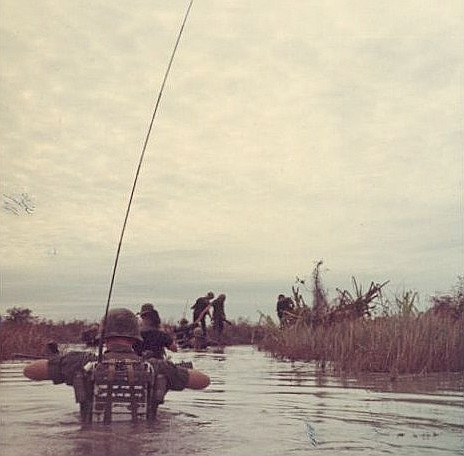
In the Vietnam war, the danger and discomforts of the infantryman’s war was shared by artillerymen and others. Under the traditional and antique name of firing parties, some artillerymen accompanied infantry companies in combat. While they were without a doubt combatants, within the strictures of the arcane twists and turns of military regulations, the artillerymen were not awarded the prized Combat Infantryman’s Badge. And their own branch had no badge that was equivalent.
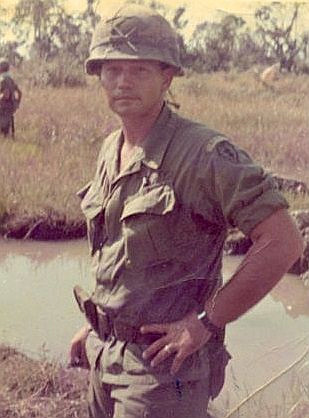
An artillery lieutenant, who was almost always called “Killer”—in reference to the artillery’s destructive prowess on the battlefield, was the constant companion of infantry company commanders. In Company B of the Second Wolfhounds during the last months of 1969 and early 1970, Lieutenant James F. Anderson was the Forward Observer, or FO in Army jargon. In the Vietnam war, whenever infantry commanders were killed or incapacitated, more than one FO found himself running a rifle company for a while.
Anderson had the luck of being teamed with Captain Frank Smith, a seasoned, no-nonsense infantryman who had decided long before that he would not risk the lives of his men with rashness or ill-considered action. Smith believed in firepower, and Anderson was trained to use it to maximum effectiveness. Together they had probably the most effective commander-forward observer relationship in the Wolfhounds at that time. Their version of a technique called reconnaissance by fire set a standard within the battalion that remained an example long after both of them had departed.
At first, Anderson found the daily routine dull and looked for opportunities for excitement by accompanying individual platoons on various field operations. The ever calm, reasoning Smith taught him to look at a bigger picture, and the two of them built a professional relationship that was also tempered by mutual respect. When the company was moved to a border outpost astride the An Ninh corridor, it was a test of the relationship.
The corridor was a major route for North Vietnamese infiltrators into South Vietnam, from an area the Americans called the Angel’s Wing, based on the shape the border took at that point. The outpost was located at a village of several hundred people that the Americans called Phuoc Luu. On the maps, it was identified as Ap Binh Hoa. A boundary line between two provinces ran through the area, and infiltration routes were often chosen near these boundaries in thinly-populated areas.
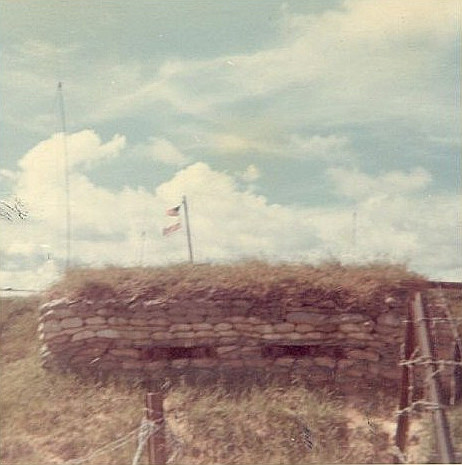
The little outpost was a tempting target for enemy attacks, but the ability to bring in accurate and deadly artillery and air strikes while using protective features of fortified positions, barbed wire, and claymore mines prevented any real attacks while the Wolfhounds were there.
Long after the war, Anderson would write a detailed and sometimes pungent memoir that would include many of the things he recalled about the life of the villagers, the war and the life of American soldiers in that environment and other places in which the unit operated. His descriptions of Phuoc Luu village and its people remain bright and perceptive today. It is a rare glimpse into the social fabric of a country in war.
Anderson and Smith returned home at the end of their Vietnam tours. Both live in retirement in Georgia today.
Lieutenant Anderson would become a teacher and coach in civilian life, but he missed soldiering. He thinks his Cherokee ancestry may have contributed to his love of adventure. In 1973, he joined the Tennessee Army National Guard and was assigned to an artlllery brigade in Chattanooga. Over a 21-year career, he held nearly every commissioned officer leadership position in the unit. When Americans took part in Desert Storm in 1991, he was a lieutenant colonel and executive officer of the brigade. He helped train a heavy artillery brigade with two 8-inch M110 battalions and one 155mm, M109 battalion.
“The big-tracked beasts that belched 200-pound projectiles and consumed diesel at the rate of 1.6 gallons to the mile were beautiful things," he said. “The smell of cordite and diesel fumes lingers still in my mind.”
In recent years, he spent time engaged in missionary work in Central America, part of it at sea in coastal areas, so the love of adventure lives on in him. But his wanderlust seems to be behind him at last. Redleg!
Copyright 2010 by Howard Landon McAllister